
“The Future of Wireless Communication: An Introduction to Li-Fi”
In today’s world, the internet has become an essential part of our daily lives. We rely on it for communication, entertainment, and access to information. One of the most popular ways to access the internet is through Wi-Fi, a wireless technology that uses radio waves to transmit data. However, Wi-Fi is not without its limitations, and a new technology called Li-Fi is emerging as a potential successor.
Li-Fi, short for Light Fidelity, is a wireless communication technology that uses light waves to transmit data. Unlike Wi-Fi, which uses radio waves, Li-Fi uses the visible light spectrum, 10,000 times larger than the radio spectrum. This means that Li-Fi can provide much higher data transfer rates, up to 224 Gbps, compared to Wi-Fi’s maximum of 7 Gbps.
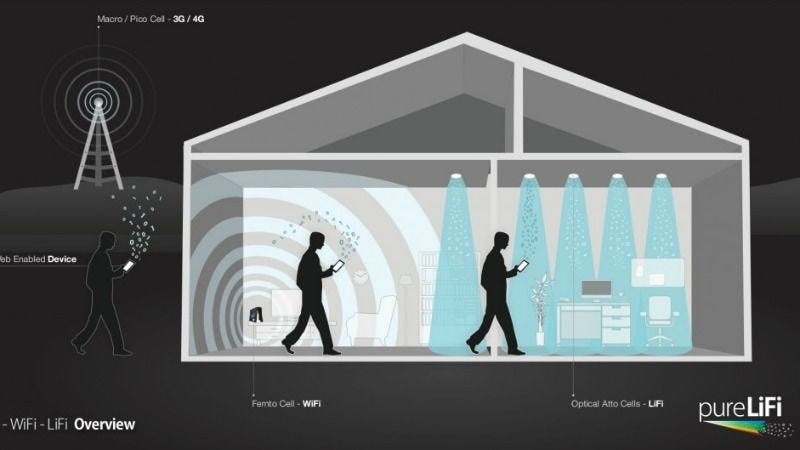
One of the main advantages of Li-Fi is that it is much more secure than Wi-Fi. Because light waves cannot penetrate walls, the signal is contained within a specific area, making it much more difficult for hackers to access. Additionally, Li-Fi does not interfere with other wireless technologies, such as Bluetooth or Zigbee, which can cause problems with Wi-Fi.
Li-Fi technology is based on modulating a light source’s intensity, such as an LED lightbulb, on transmitting data. The data is then received by a photodetector, which converts the light back into an electrical signal. This technology can be integrated into existing LED light fixtures, making it simple to install and cost-effective.
Li-Fi has a wide range of potential applications, including in homes, businesses, and industrial settings. Li-Fi can provide a fast and secure internet connection in homes, while in industries, it can improve communication and increases productivity. Li-Fi can be used in industrial settings for machine-to-machine communication, such as in the Internet of Things (IoT) applications. Additionally, Li-Fi can be used in transportation, such as in cars and airplanes, and in healthcare, such as in hospitals.
Li-Fi is still in its early stages of development, but it has the potential to revolutionize wireless communication. Its high data transfer rates, security, and lack of interference make it an attractive alternative to Wi-Fi. As more research is conducted and products are developed, Li-Fi may become a common sight in our homes and workplaces.
In conclusion, Li-Fi is an exciting new technology that has the potential to change the way we access the internet. Its high data transfer rates, security, and lack of interference make it an attractive alternative to Wi-Fi. As technology evolves, we may soon see Li-Fi becoming a common sight in our homes and workplaces.
